

Stars, 2026, Lisa Waup, screen-painting on cotton rag paper, water-based ink, reflective ink, 262cm x 154cm.
It’s hard to know where to start with introducing mixed cultural First Nations artist Lisa Waup, such is the depth and breadth of her talent.
The list is long: print maker, weaver, installation artist, textile artist, muralist, jewellery maker, fashion creator... Her work is prolific and significant, and feels very alive. Large scale yet intimate, immediate yet timeless, material yet spiritual.
It has an indelible emotional component too: you can’t be unaffected by what you see, feel, touch or wear. Her exhibition titles also go straight to the heart.
Present in public and private spaces around Australia, Lisa’s work transforms. Her latest large-scale commission for the City of Melbourne turns a dull hoarding at University Square in Carlton, Naarm/Melbourne, into a profound experience, visually and spatially transporting us back to the time before colonisation. (Update from Lisa: This hoarding has since been removed sadly – the hoarding was placed as a marker for what is to come. At present Lisa is working on three sculptures for University Square.)
Eighty-three metres in length and in stark black and white, the beautiful, continuous image gracefully reminds us that Country and caring for it, is foundational to human existence - a two-way relationship. Without it, we’re toast.
Placed at the “heart of the precinct”(1) - and for that matter, at the heart the city – lovely lines guide us back to a kind of ‘pre-time’: before concrete, before powerlines and before skyscrapers crowded out the light. Some serious “Mother” energy is going on.
Within these creative spaces - and through her work as a lecturer (Drawing and Printmaking Program at Victorian College of the Arts, University of Melbourne) and an eloquent speaker - Lisa Waup reaches many.
“Memory is a moment in time that has been suspended in space,” she said in a 2025 NITV interview (2). “Every day of the year we need to take care of Country.” She inspires us to reflect on and remember what’s important.
After participating in two group shows at Stockroom - microcosm/macrocosm (2025) and Plant Life earlier in 2026 - Lisa Waup will have her first solo show Stockroom, when light remains.
Opening 21 November and running until 3 January 2027, she will present a range of large and smaller scale new works screen-painted onto various media including paper, khadi and hessian.
They continue her deeply immersive and moving conversation through printmaking, and a passion for connecting people to place and to those who have gone before.
Also a curator and a mother, Lisa Waup is one busy woman! She kindly shared time to answer questions about when light remains.
Interviewee: Lisa Waup. Storyteller: Megan Spencer.
Stockroom: You work with so many different types of media and materials – weaving, paper, printmaking, painting, photography, sculpture, fashion and textiles, and more! What kind of work will you be bringing to Stockroom? Could you tell us about when light remains, and the pieces that will be in it?
Lisa Waup: For when light remains at Stockroom, I’ll be presenting a collection of works screen-painted onto paper and hessian using phosphorescent and reflective inks, with hand-stitching incorporated into some pieces.
Stars are a central motif throughout the exhibition, representing ancestry and our ongoing connection to those who came before us. I’m interested in how the works shift with changing light, appearing subtle during the day before softly illuminating in darkness.
For me, the exhibition is about the stories, knowledge, love and connections we carry with us, and the enduring presence of those who continue to guide and watch over us.
SR: What themes will you be exploring – or digging even deeper into – with when light remains? What kind of conversation will you be having with the audience?
LW: With when light remains, I’m exploring ancestry, memory, connection and the idea that those who came before us continue to be present in our lives, even when they are no longer physically here.
I’m interested in the stars as symbols of guidance, protection and storytelling, and how knowledge and stories are carried across generations. The stars also represent hope, possibility and the potential of what lies ahead.
I hope the works invite audiences to reflect on their own connections, the people they carry with them, and how our past and present can inform the possibilities of our future.
SR: Your work speaks on so many levels: it’s epically beautiful and delicate, while also addressing ‘big’ themes around culture, precarity, hope and connection. In your words, “the works bring together the cosmic and the intimate, the ephemeral and the enduring.”
With those contrasts in mind, I wonder what it might be like for you, when it comes to making your work? Is it an emotional experience for you? Would you share some of that process with us, especially in relation to creating and making when light remains? How are you affected?
LW: I find making work is often an emotional and personal process. My practice is a way of working through thoughts, memories and experiences, and of connecting things that are sometimes difficult to put into words.
With when light remains, I’ve been thinking a lot about ancestry, family, loss and the connections that continue beyond physical presence.
The process of screen-painting, layering materials and hand-stitching is quite meditative for me; there is a slowness and repetition that allows time to think and reflect. I’m drawn to the contrast between the delicate and the strong, the visible and the unseen.
I think the works hold a little of all this including moments of vulnerability, hope and possibility. Ultimately, making is a way for me to honour the past while also looking towards the future.
SR: You’ve exhibited far and wide, throughout the lands of this continent and also internationally, in public and private spaces. You teach, and your work reaches so many people.
With your broad perspective as an artist, and given that connection to Country is so fundamental to your work, I wonder what your thoughts might be around exhibiting in regional art galleries and spaces? Are they important – and why?
And is there something unique or special about bringing your work to the regions?
LW: I think regional galleries and art spaces are incredibly important. They create opportunities for people to experience art and connect with artists without having to travel to major cities.
There is something special about bringing work into regional communities, where connections to Country, family, history and place can be so deeply felt.
As an artist, I value the opportunity to share my work with different audiences and to create conversations that might not otherwise happen. My own practice is grounded in connections to Country, family and storytelling, so exhibiting regionally feels particularly meaningful.
I also think it is important that First Nations voices and contemporary art practices are visible and accessible across regional communities, not just in metropolitan spaces. These spaces can create lasting connections, opportunities for learning and a sense of belonging.
SR: It might be fair to say that Lisa Waup exhibitions are evocative and provocative. For the people who come to view when light remains at Stockroom, what would you like them to take away with them, internally, after experiencing it?
LW: I hope people leave the exhibition with a sense of connection, hope and possibility. I’d like them to reflect on the people, stories and histories that have shaped who they are and to consider the ways those connections continue to live within us.
For me, when light remains is about recognising that even in times of darkness or uncertainty, there is always light to be found.
I hope the works offer a sense of comfort and reassurance but also encourage people to look forward and to imagine what is possible.
SR: Is there anything else you’d like to share about when light remains, or your work as an artist, that might be important for people to know?
LW: I think it’s important to understand that my work is deeply personal, but I also hope it creates space for others to bring their own stories and experiences to it.
My practice is constantly evolving, moving between materials, processes and ideas, but at its heart it is about connection.
With when light remains, I hope to remind people that even when things change or people are no longer physically with us, the love, knowledge and stories they leave behind continue to shape us.
These connections remain with us, carried forward through our memories and the way we move into the future.
—-
Thanks so much to Lisa Waup for the interview, which was conducted by email. when light remains opens at Stockroom, Gallery Two on Saturday 21 November 2026 and runs until Sunday 3 January 2027.
To find out more about when light remians, please contact Magali Gentric at Stockroom: info@stockroom.space
Photo by Hayler Millar-Baker.
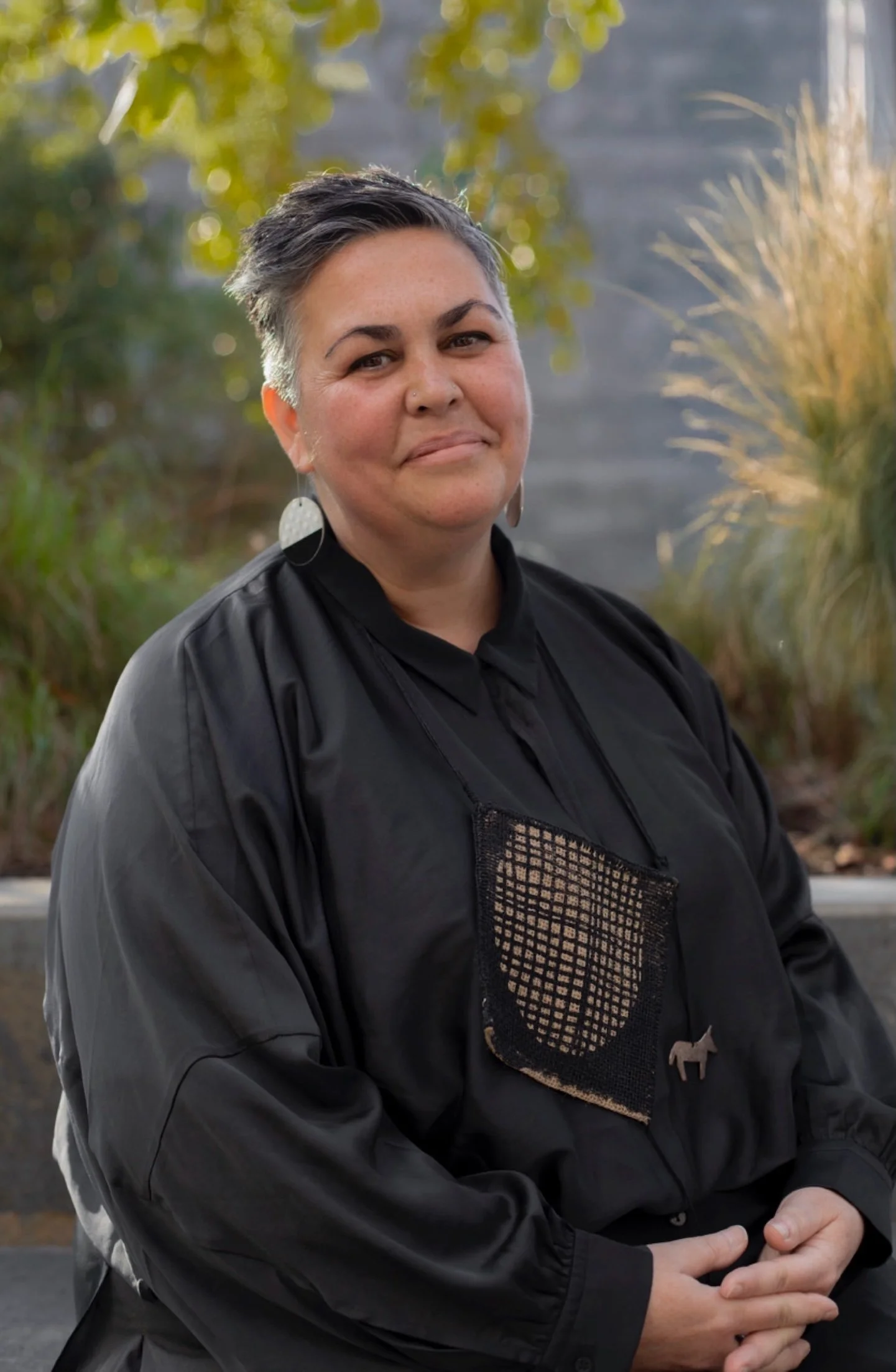
Artist Lisa Waup. Photo by Hayley Millar-Baker.