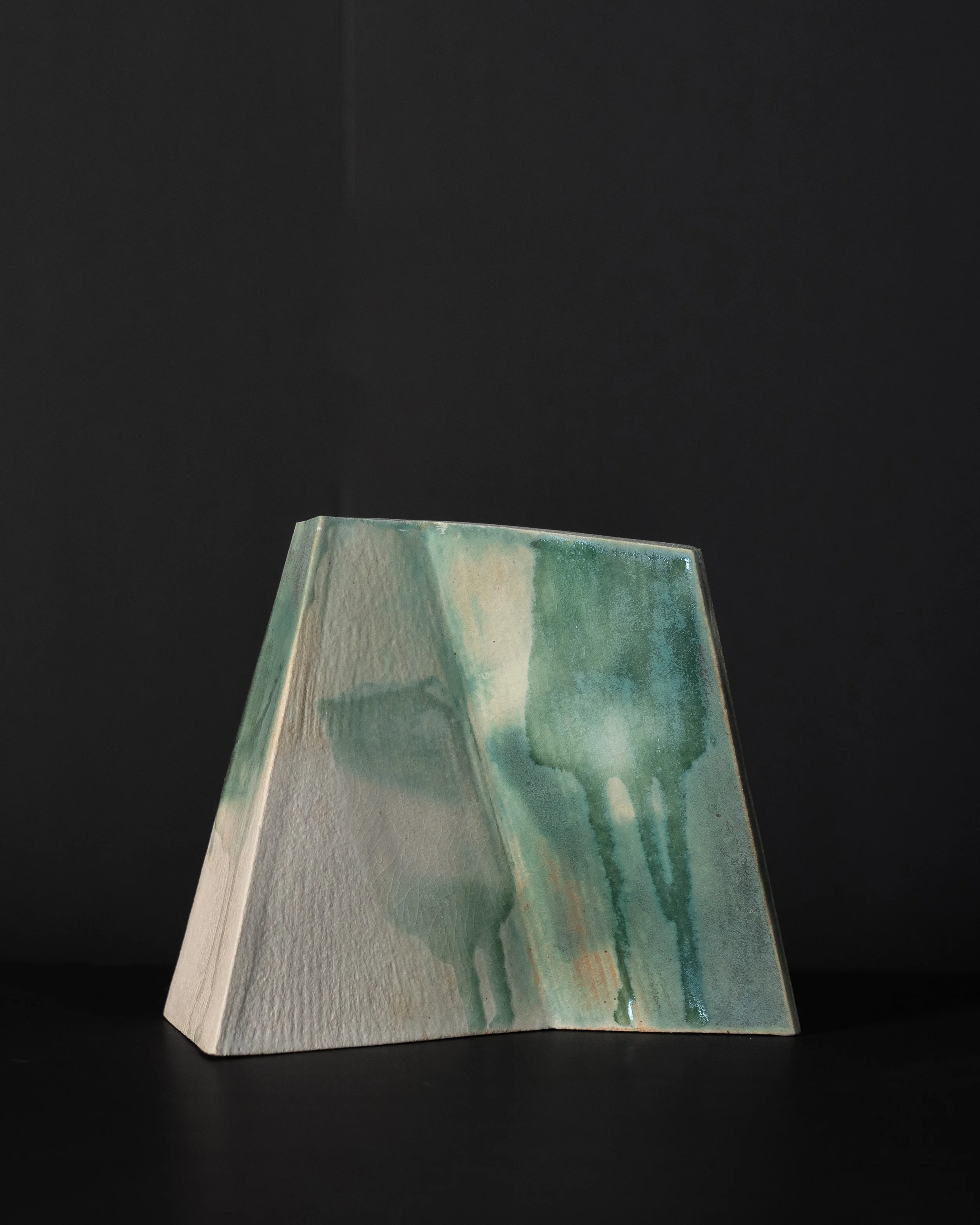
Slab

Stockroom Kyneton, ceramic space
16 March / 21 April 2024

ANGELA HAYES
Slab

It all starts with a Slab: A slice from a lump of clay - simple and unformed. The slab commences a ceramic hand-building process and also describes the ceramic form. It is the fabric of Angela Hayes’ ceramics and the canvas for expression.

With slab, the artist soothes her inner drama of contradictions. Seeking control and discipline with cautious crafting of form and edge, which is then abandoned for freedom in expression with unpredictable glaze finishes.

Angela Hayes’ ceramic sculptures originate from the study of the classic pouring vessel many years ago. The lip, the body, the foot, the spout, and the handle have evolved from wheel-thrown vessels to contemporary slab-made architectonic forms. Her work has departed from the functional constraints of the vessel and instead has become a receptacle for her artist’s voice.

Hayes studied Fine Arts - Ceramics at Queensland College of Art and later completed a Bachelor and Master of Landscape Architecture at the University of Melbourne. Her landscape architecture design practice, research, and teaching have developed a distinct style and keen eye for design which is demonstrated in her ceramic work. Angela has received numerous awards for her design work. She has exhibited her ceramic sculptures interstate, in China, and at numerous galleries in Melbourne.

Hayes creates ceramic sculptures from her inner-city studio in Melbourne. She finds inspiration in her urban environment through experimentation with traditional ceramics processes and refinement of new technical discoveries.

I AVAILABLE ARTWORKS I

JOSHUA COCKING

A foreign body, 2024, oil on canvas, framed, 61 x 61 cm

Stockroom Kyneton, gallery two
16 March / 21 April 2024

JOSHUA COCKING
A foreign body

During Cocking’s years living in remote Indigenous communities, he was always conscious of being an outsider. That despite Cocking’s good intentions, he was an interloper in an unfamiliar place. These paintings capture implausible orbs floating in the landscape, attempting to blend into their surroundings, reflecting and absorbing colour. But ultimately, they remain a foreign body; they do not belong.  The Kimberley works represent Joshua Cocking’s ongoing attempts to immerse in a country and culture that is not his own. Conversely, the landscapes of south-western Victoria where he grew up are now also foreign; a sense of belonging eroded over half a lifetime lived away.

I MORE INFO I

Nature Nurture

Stockroom Kyneton, gallery one
03 February / 10 March 2024

GREG WOOD
Nature Nurture

Greg Wood is a painter of the earthy and ethereal. The observation of atmospheric shifts in landscapes has been central to his practice for the past 25 years. He is attracted to observing the dynamic and subtle states of transformation enhanced by changing conditions, weather, and light.

In a recent residency in the ex-mining town of Queenstown, West coast of Tasmania,

Wood observed and created a series he describes as ‘resurrected landscapes’, images of places altered by human activity and in the process of regeneration. He describes these landscapes as occupying a liminal space between abstraction and realism, reminiscent of his style, that is, the physical abstraction wrought by human intervention and the shifting forces of atmosphere in the environment and the realism of nature’s capacity for remodelling itself as it heals. He describes the act of painting these wounded landscapes as acts of restitution and contrition.

Wood currently resides in one such landscape, the Central Victorian Goldfields, on Dja Dja Wurrung country. Described by local indigenous people as ‘Upside down country’ after the disruptions of the gold rush, this deeply disfigured landscape, marred and churned by mining, is in the process of reconfiguring. This singular landscape, with its saturated coppery hues and shadowy crenulations, impels Wood to create works that hold the unsettled beauty of a place both devastated and re-emerging. It is in this way that his art bears witness to the immense power of nature’s capacity for adaptation and repair.

For Wood, the specifics of place are not as important as the emotional and figural afterimages that endure. He paints places traversed through sensory impression, inviting the viewer to enter the felt sense of place, inciting flares of memory and emotion – landscapes of the familiar and unfamiliar. Wood describes his work as a ‘slow release’ –the nuance of his paintings gradually revealing themselves to the viewer. The art of Melbourne tonalist Clarice Beckett has been a formative influence for him, as revealed in his translucent, gestural layers of muted colour, flattened form, merging tones, and diffuse light.

I AVAILABLE ARTWORKS I